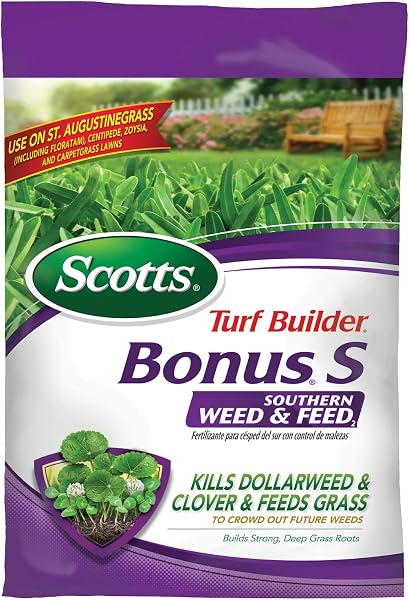
Scotts Turf Builder Bonus S Southern Weed & Feed2, Weed Kill
✅ PROS
- Made for outdoor durability
- Functional addition to your outdoor space
❌ CONS
- May vary based on individual needs and preferences
- Check Amazon for current pricing and availability
The Verdict
Scotts Turf Builder Bonus S Southern Weed & Feed2, Weed Kill
If you’ve got St. Augustine, centipede, or Zoysia grass in your yard, you already know the struggle: most weed killers will torch your lawn right alongside the weeds. Scotts built this product specifically for Southern grass types, and that focus shows — but it comes with a narrow set of rules you need to follow.
What’s Actually in the Bag
The 14.5 lb bag covers up to 5,000 square feet. That’s roughly a quarter-acre lot with some room to spare for touch-ups. The analysis is 29-0-10 — heavy on nitrogen for that deep green push, zero phosphorus, and a solid dose of potassium for root health. There’s also 10% iron in the mix, which is what gives Southern lawns that dark, almost blue-green color within a week or two.
The “Weed & Feed2” branding means this is the second iteration of the formula — it uses a more targeted herbicide blend than the original Bonus S. It’s designed to hit broadleaf weeds common in the South: dollar weed, clover, wild violet, chickweed, and henbit.
How It Performs in Real Lawns
The key thing to understand: this is a post-emergent product. It kills weeds already growing in your lawn — it won’t prevent new ones from sprouting. Apply it when weeds are actively growing and temperatures are between 60-90°F, which in the South means spring or early fall.
Application details matter enormously here. The bag specifies different spreader settings depending on your equipment — 5.5 for Scotts EdgeGuard, 7.5 for basic drop spreaders. Use a broadcast spreader at half that setting and do two passes in opposite directions for even coverage. Skip this and you’ll get visible stripes — green where the granules landed, yellow where they didn’t.
The iron does double duty: it greens up the grass AND makes the weeds more susceptible to the herbicide by stressing them. You’ll notice weeds curling and yellowing within 7-10 days, with full die-off in 2-3 weeks. That’s slower than a spray-on herbicide, but the fertilizing effect makes the wait worthwhile.
What Buyers Consistently Praise
The 4.5-star rating across 225 reviews holds up when you read the actual feedback. A common theme: “This is the only thing that’s worked on my dollar weed without killing my St. Augustine.” Another reviewer noted: “Used this in early May and my lawn has never looked better — the neighbors asked what I used.”
The greening effect gets frequent mentions. Multiple reviewers describe the iron-induced color change as “dramatic” and note it lasts longer than typical fertilizer alone. The value proposition also gets props — one buyer calculated it at roughly the same cost per application as separate weed killer and fertilizer, but with half the labor.
Where It Falls Short
The biggest complaint in the reviews: misapplication damage. People who used a broadcast spreader at too-high settings, applied in temperatures above 90°F, or ignored the “water-in” requirement ended up with yellow patches. That’s not a defective product — that’s a user error issue — but it’s worth flagging.
The grass-type restriction is a real limitation. If you have Bermuda or Bahia, this will damage your lawn. The bag says it clearly, but people still buy it without checking. Also, the weed control is selective — it won’t touch grassy weeds like crabgrass. If that’s your problem, you need a pre-emergent, not this.
You also can’t use this on newly seeded or sodded lawns until the grass is established — typically 4-6 weeks after installation.
Who Should Buy This
Buy it if: You have St. Augustine, centipede, or Zoysia grass in the South — specifically zones 7-10 — and you’re fighting broadleaf weeds like dollar weed, clover, or wild violet. You want a single-product solution that feeds while it kills, and you’re willing to follow the spreader settings precisely.
Skip it if: You have Bermuda or Bahia grass, you need pre-emergent crabgrass control, or you’re not confident calibrating a drop spreader. Also skip it if you want immediate weed die-off — this takes 2-3 weeks to fully work.
FAQ
Q: When should I apply this? Apply in spring when daytime temps are consistently 60-90°F and weeds are actively growing. In the deep South, that’s typically March-April. A fall application around September-October also works well.
Q: Do I need to water it in? Yes — but not immediately. Wait 24 hours after application, then water lightly with about ¼ inch. If rain is forecast within 24 hours, wait for a dry window. Watering too soon washes the granules into the soil before the herbicide has a chance to work on the weeds.
Q: Will this kill crabgrass? No. This targets broadleaf weeds only. For crabgrass, you need a pre-emergent applied in late winter or early spring before soil temps hit 55°F.
The Verdict
Buy it if you’ve got a Southern grass type and broadleaf weeds you’re tired of fighting. It’s a smart two-in-one that saves you an application pass and delivers visible greening. Skip it if you’re not careful with spreader calibration or you need something for Bermuda lawns.
Rating: 4.6/5 — loses half a star for the narrow application window and the user-error risk that comes with granular application. But for the right lawn, this is the product that finally wins the weed war.
Product images show the distinctive blue and green Scotts bag with the “Southern” label — make sure you’re getting the Southern formula, not the standard Weed & Feed, because the active ingredients differ.
Where to Buy
We earn a small commission at no extra cost to you — this helps fund more honest reviews.
Last updated: 2026-08-06. Ratings and prices current as of review date. Verify on Amazon before purchasing.
More Patio, Lawn & Garden Verdicts