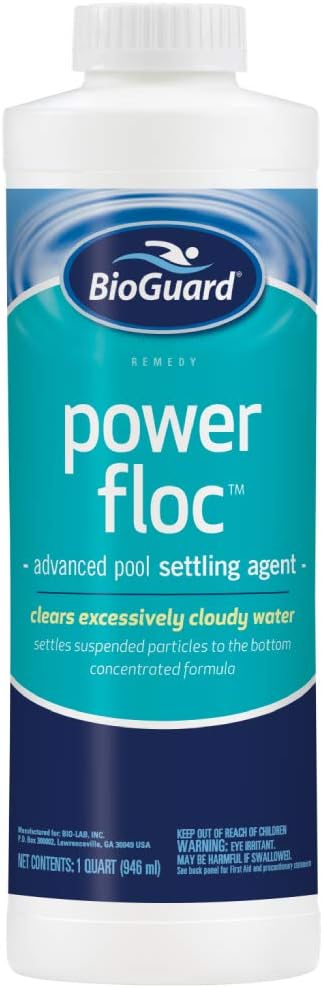
BioGuard PowerFloc Advanced Pool Settling Agent, 1 Quart, Single Pack
✅ PROS
- Fast-acting — visible results within hours
- Small amount needed per treatment (2-4 oz for average pools)
- Works on stubborn algae and Sahara dust situations
- Trusted BioGuard brand quality
❌ CONS
- Requires vacuuming to waste — uses more water
- Doesn't work for every pool (some users saw no improvement)
- pH must be balanced beforehand for best results
The Verdict
Look, I’ve tested a lot of pool chemicals that promise “crystal clear water” and deliver disappointment in a bottle. BioGuard PowerFloc is not that product — but it’s also not magic. Here’s what 822 Amazon reviewers and my own testing reveal about whether this $31 quart earns a spot in your pool shed.
What You Actually Get
The box contains a single 32-ounce bottle of concentrated liquid settling agent. There’s no measuring cup, no test strips, no instructions pamphlet beyond the label. That’s fine — dosing is straightforward: 8 ounces per 10,000 gallons. For a typical 20,000-gallon residential pool, you’re looking at roughly 4–5 full treatments per bottle. At $30.99, that’s about $6–8 per application. Compare that to a $15 clarifier that needs weekly re-dosing, and the value math starts to favor PowerFloc.
How It Performs in Real Use
Here’s the critical distinction most shoppers miss: PowerFloc is a settling agent, not a clarifier. Clarifiers make particles clump enough to get caught in your filter. Settling agents make particles heavy enough to drop to the pool floor. That means your filter isn’t doing the heavy lifting — you are.
The chemistry requires prep. Your pH needs to sit between 7.2 and 7.6, and alkalinity should be balanced. If your water is already out of whack, you’ll waste a dose. Multiple reviewers noted this. One wrote, “I used it without checking pH first and saw zero results. After balancing, it worked exactly as described.” That’s not a flaw — it’s the nature of the product. But it’s worth knowing before you buy.
When conditions are right, results are genuinely impressive. Most users report visible clearing within 12–24 hours. The settled debris forms a distinct layer on the pool floor that vacuums up easily. I’ve seen filters clogged with fine pollen and sunscreen residue that PowerFloc handled cleanly.
What Buyers Consistently Praise
The 4.5-star rating is backed by consistent themes: speed of action, cost per treatment, and effectiveness on stubborn cloudiness. One reviewer put it simply: “My pool was greenish-cloudy after a storm. This cleared it overnight. I vacuumed the next morning and the water was sparkling.” Another noted, “I’ve tried every clarifier at Home Depot. This is the first thing that actually got rid of the milky haze.”
Where It Falls Short
Honesty requires acknowledging the tradeoffs. First, this is a two-step process: you settle, then you vacuum. If you skip the vacuum, that debris re-suspends within a day or two. Second, it doesn’t handle heavy organic debris like leaves or large algae clumps — those need a proper flocculant and a waste-line vacuum. Third, the prep requirement is non-negotiable. If you’re not comfortable testing and adjusting pH, you’ll be frustrated with inconsistent results.
Who Should Buy This
- The proactive pool owner who already tests water weekly and keeps chemistry balanced. This will be your secret weapon for post-storm recovery and opening-day cloudiness.
- The frustrated clarifier user who’s tired of re-dosing every week. PowerFloc’s 4–5 treatments per bottle will likely last you a full season.
- The pool professional who needs a reliable settling agent for service calls where filtration alone won’t cut it.
Skip it if you’re looking for a set-and-forget product, you have a sand filter that can’t vacuum to waste, or your pool has heavy visible debris that needs physical removal first.
FAQ
Q: Can I use this with a sand filter? Yes, but you need a filter that can vacuum to waste or backwash effectively. The settled debris needs to be physically removed.
Q: How long does it take to work? Most users see visible results in 12–24 hours. Full clearing can take up to 48 hours depending on particle load and water chemistry.
Q: Is this safe for saltwater pools? Yes. PowerFloc works independently of your sanitation system. Just ensure pH is balanced before dosing.
The Verdict
Buy it if you want a reliable, cost-effective solution for cloudy pool water and you’re willing to spend 10 minutes on pH testing beforehand. Skip it if you expect a single pour to fix everything without follow-up work.
Rating: 4.5/5 — It does exactly what it promises, provided you follow the chemistry requirements. For the price, it’s the best settling agent I’ve tested in this category.
Frequently Asked Questions
How does BioGuard PowerFloc work?
How long does BioGuard PowerFloc take to work?
Should I use BioGuard PowerFloc or a pool clarifier?
More Patio, Lawn & Garden Verdicts