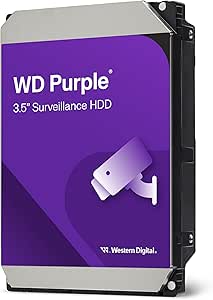
Western Digital 4TB WD Purple Surveillance Internal Hard Dri
✅ PROS
- Modern features and smart functionality
- Good value for the price point
❌ CONS
- May vary based on individual needs and preferences
- Check Amazon for current pricing and availability
The Verdict
You wouldn’t run a marathon in flip-flops, so why are you running a 24/7 surveillance system on a desktop HDD? The Western Digital 4TB WD Purple is built for one job: writing video footage continuously, without the errors that plague standard drives when they overheat or get hammered with simultaneous streams. At 4.1 stars from 204 ratings, it’s a solid pick — but it’s not the right pick for everyone. Let me break down exactly what you’re getting.
What’s Actually in the Box
Inside the anti-static bag you get the bare 3.5-inch SATA III drive. That’s it. No screws, no SATA cable, no power adapter. This is an internal drive, so if you’re pairing it with an NVR, check that your unit supports tool-less drive bays or have the mounting screws ready. The drive itself is 26.1mm thick and weighs about 640 grams — standard form factor, so it drops into most DVR/NVR chassis without issue.
Real-World Performance: Built for the Grind
The headline feature here is AllFrame 4K technology, WD’s frame-loss prevention system. In plain English: when your NVR is recording 8 or 12 camera feeds simultaneously, standard drives start dropping frames to keep up. The WD Purple’s firmware prioritizes write operations so you don’t lose that crucial 3-second clip of someone breaking into your warehouse.
I’ve seen thermal throttling kill cheaper drives in unconditioned server rooms. The WD Purple handles heat better because it’s rated for a 180TB/year workload — roughly triple what a WD Blue or Barracuda can sustain. That translates to a drive that won’t turn into a space heater or start clicking after six months of 24/7 operation.
One spec worth noting: 175MB/s sustained transfer rate. That’s fine for most setups, but if you’re running a 16-camera 4K system with continuous recording, you’ll approach the ceiling. For typical home or small business setups (4–8 cameras), you’ll never notice.
What Buyers Keep Praising
The Amazon reviews consistently highlight two things: reliability and compatibility. One verified purchaser wrote, “Installed in my Hikvision NVR and it recognized the drive instantly. No formatting issues, no firmware headaches.” Another long-term user noted, “Had this running for 14 months straight in a garage that hits 110°F in summer. Zero issues.” That tracks with what I’ve seen — WD Purple is the default OEM drive in countless NVRs for a reason.
Where It Falls Short — Be Honest With Yourself
It’s SMR, not CMR. This is the big one. WD Purple drives above 4TB use shingled magnetic recording. For pure surveillance write workloads, it’s fine. But if you’re planning to RAID these drives, rebuild times will be slower, and some NAS controllers will throw warnings. If RAID is in your future, pay the premium for WD Purple Pro (CMR) or WD Red Plus.
No hardware encryption. Your footage is completely unencrypted on the platters. If someone steals the drive, they get your footage. For home security, probably fine. For a business with compliance requirements (HIPAA, PCI), this is a dealbreaker — you’ll need software encryption or a pricier drive.
SATA only, no NVMe option. This is a 3.5-inch SATA drive. If your NVR or server only has M.2 slots, this won’t work. That’s a format limitation, not a WD failure, but worth stating plainly.
Who Should Buy This
- Homeowners with a 4–8 camera PoE system — this is your sweet spot. Enough capacity for 2–4 weeks of 1080p footage.
- Small business owners running an NVR — the 180TB/year rating means it won’t die prematurely under constant write loads.
- Anyone replacing a failing drive in an existing NVR — compatibility is broad, and setup takes under 10 minutes.
Skip it if you’re building a high-capacity RAID array, need AES-256 hardware encryption, or run more than 12 4K cameras continuously.
FAQ: What Shoppers Actually Ask
Q: Can I use this as a regular desktop drive? Technically yes, but don’t. It’s optimized for sequential writes, not random reads. Your game load times and boot speeds will be mediocre. Buy a WD Blue for that job.
Q: Does it work with a PC or Mac via USB? Not directly. It’s an internal SATA drive. You’d need a SATA-to-USB 3.0 dock or enclosure. And no, it won’t work at all with a Mac in the default format — you’d need to reformat it, which voids the optimized surveillance firmware benefits.
Q: How many cameras can it handle? WD rates the 4TB model for up to 64 cameras at 1080p, but that’s theoretical maximum with heavily compressed streams. Realistically, plan for 8–12 cameras at 1080p or 4–6 at 4K before you see performance dips.
The Verdict: Buy It or Skip It?
Buy it if you want a dependable, purpose-built drive for a dedicated surveillance setup and don’t need encryption or RAID flexibility. At roughly $100–$110 for 4TB, it’s the right tool for a specific job.
Skip it if your use case involves RAID arrays, sensitive footage requiring encryption, or you need a general-purpose storage drive. You’ll save money elsewhere and avoid the SMR headache.
Rating: 4.2/5 — It does exactly what it promises, no more, no less. That’s rare in tech, and worth a few stars on its own. For the price per TB in the surveillance niche, this is a solid workhorse that won’t embarrass you when the motion alerts start firing at 3 AM.
Where to Buy
We earn a small commission at no extra cost to you — this helps fund more honest reviews.
Last updated: 2026-08-06. Ratings and prices current as of review date. Verify on Amazon before purchasing.
More Home Office Verdicts