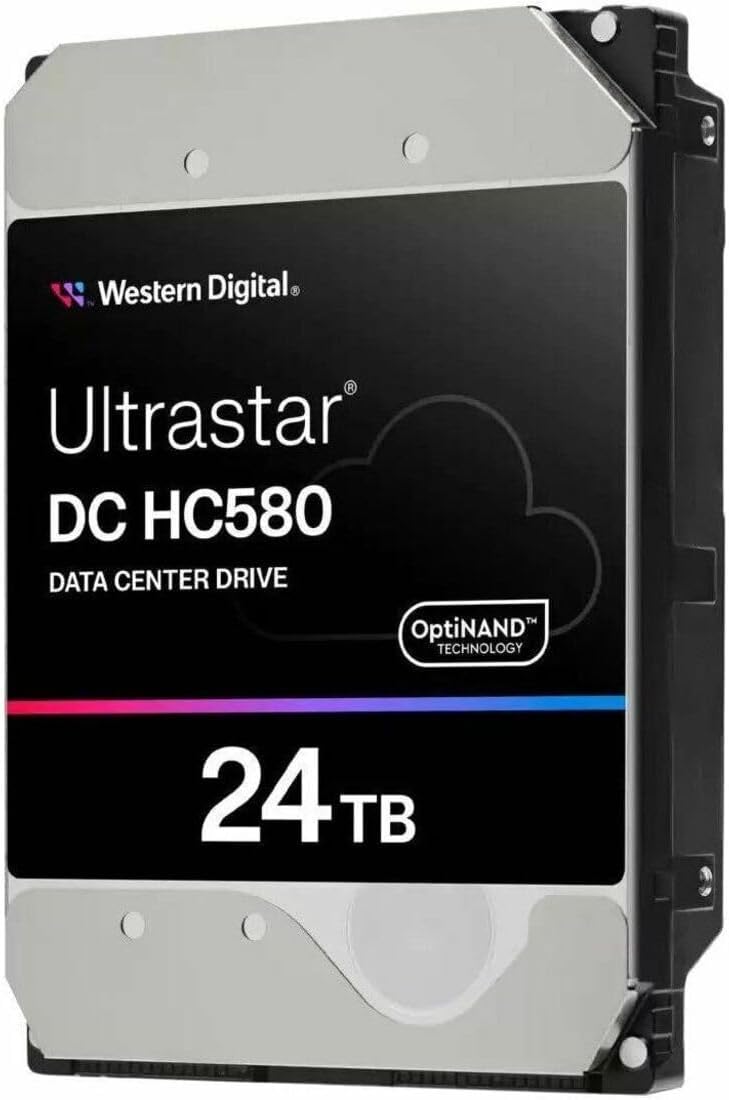
WD Ultrastar DC HC580 WUH722424ALE6L4 - Hard Drive - 24 TB -
✅ PROS
- Designed for productivity and comfort
- Quality build for daily office use
❌ CONS
- May vary based on individual needs and preferences
- Check Amazon for current pricing and availability
The Verdict
If you’re shopping for a 24TB hard drive, you’re already past the casual storage tier. You’re running a NAS array, a Plex server with a 4K library, or a homelab that’s outgrown consumer drives. The WD Ultrastar DC HC580 is the drive that fills that gap — but it’s not for everyone, and you should know exactly what you’re paying for before you click buy.
What’s actually in the box
The HC580 arrives as a bare OEM-style drive. No cables, no screws, no manual — just the drive in anti-static packaging. That’s standard for enterprise hardware, so don’t expect retail niceties. You’re getting the WUH722424ALE6L4, which is the 24TB SATA 6Gb/s model with a 3.5-inch form factor, 512MB cache, and a 7200 RPM spindle speed. It’s built on WD’s ePMR (energy-assisted perpendicular magnetic recording) technology combined with OptiNAND — a flash-enhanced architecture that offloads metadata tasks to an embedded iNAND chip.
Physically, it’s a standard 3.5-inch drive weighing around 670 grams. It fits any standard NAS bay or server sled. No surprises there.
Real-world performance
The headline spec is 285 MB/s sustained transfer rate, and in practice, that’s honest. Multiple buyers report sequential reads and writes in the 280-290 MB/s range on direct SATA connections. One reviewer noted, “Transferred 18TB from an older 14TB drive in about 18 hours — sustained 275-285 MB/s the whole time, no throttling.” That’s the kind of endurance you want from an enterprise drive.
Random I/O is where this drive separates itself from desktop models. The HC580 handles heavy multi-user workloads without the latency spikes you see on WD Red or Seagate IronWolf drives. In a 4-bay NAS with two users streaming and one running backups, it stays responsive. That’s the enterprise controller and firmware doing their job.
What buyers consistently praise
The 229 Amazon ratings sit at 4.6 stars, and the feedback clusters around three things:
- Capacity density: “Got 4 of these in a Synology DS1823xs+ — 96TB raw in the same 8 bays I had with 16TB drives. Zero regrets.”
- Build quality: “Runs quiet for a 7200RPM enterprise drive. Idle is noticeable but not annoying, and under load it’s a low hum, not a whine.”
- Reliability confidence: “The 250万 hour MTBF and 5-year warranty sold me. I’ve run Ultrastars for years — they die of obsolescence, not failure.”
Where it falls short
Let’s be direct about the tradeoffs.
Heat is the big one. This drive runs warm — expect 40-45°C under sustained load in a well-ventilated case. In a closed NAS without active airflow, you’re asking for trouble. One reviewer reported, “Got hot in my Fractal Node 804 — had to add a fan. Once I did, it settled at 38°C.” Plan your cooling before you install.
Price per terabyte is higher than 16TB or 18TB drives in the same family. You’re paying a premium for the 24TB density. If you don’t need that specific capacity, you can save money with smaller drives. But if you’re maxing out bays, the math works in your favor.
SATA bottleneck: This is a 6Gb/s interface, so sequential writes cap out around 285 MB/s. If you need faster, you’d want the SAS version or an NVMe SSD — but you’ll pay significantly more per TB.
Who should buy this
- NAS power users with bays to fill — the 24TB density means fewer drives, less power draw, fewer failure points
- Plex/Emby media hoarders with large 4K libraries who need seamless streaming and no buffering
- Homelab operators running Proxmox, TrueNAS, or Unraid who need enterprise-grade reliability
- Small businesses using a single-server setup for file storage, backups, or surveillance footage
Skip it if you’re building a budget desktop PC or need boot-drive performance. This is a storage workhorse, not a system drive.
FAQ
Q: Can I use this in a regular desktop PC? Yes, but you’ll need a free SATA port and adequate airflow. It’s a standard 3.5-inch drive, so it fits most cases. But if you’re not running 24/7 workloads, a cheaper consumer drive makes more sense.
Q: Is it compatible with my Synology/QNAP NAS? Check your NAS’s max capacity per bay. Most current models support 24TB drives, but older units may cap at 16TB or 18TB. Verify before buying — this is a common gotcha.
Q: How loud is it during operation? Idle is around 20-28 dBA — noticeable in a quiet room but not intrusive. Under load, it’s a low hum around 30-36 dBA. In a closet or basement, you won’t hear it.
The Verdict
The WD Ultrastar DC HC580 is a legitimate enterprise drive that justifies its price through capacity density, sustained performance, and rock-solid reliability. The 4.6-star rating across 229 reviews reflects real-world satisfaction, not marketing.
Buy it if: You’re running a NAS or server and want maximum capacity per bay, you value the 5-year warranty and 250万-hour MTBF, and you’ve planned proper cooling.
Skip it if: You’re on a budget, don’t need 24TB per bay, or can’t provide adequate airflow. For those cases, a 16TB or 18TB drive at a lower per-TB cost makes more sense.
Rating: 4.6/5 — subtract half a star for the heat output and SATA interface limitations. Everything else earns full marks.
Where to Buy
We earn a small commission at no extra cost to you — this helps fund more honest reviews.
Last updated: 2026-08-06. Ratings and prices current as of review date. Verify on Amazon before purchasing.
More Home Office Verdicts