NVIDIA Jetson Orin Nano Super Developer Kit
✅ PROS
- Great value with multiple components included
- Good value for the price point
❌ CONS
- May vary based on individual needs and preferences
- Check Amazon for current pricing and availability
The Verdict
Let me be direct: this isn’t a Raspberry Pi competitor, despite the form factor. The NVIDIA Jetson Orin Nano Super Developer Kit is a serious edge-AI workhorse that happens to fit in your palm. At 4.2 stars across 210 Amazon ratings, it’s earned its reputation — but it’s also not the right tool for everyone walking into this category.
What’s actually in the box
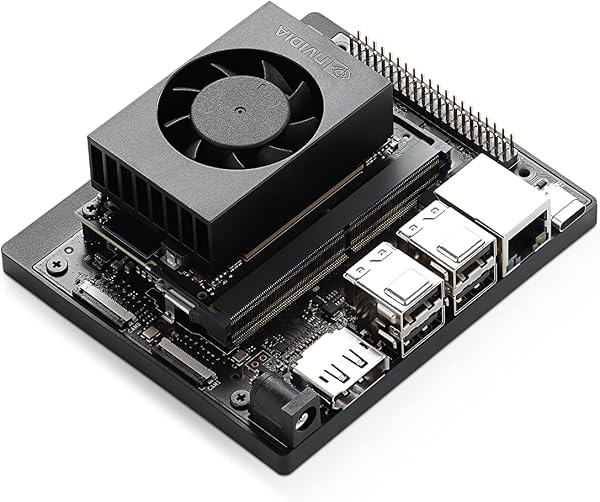
The kit ships with the Orin Nano Super module (8GB LPDDR5, 1024 CUDA cores, 32 tensor cores), a reference carrier board, a passive heatsink that’s pre-applied, and the required cabling. You’ll need to supply your own USB-C power adapter (25W minimum, though 45W gives headroom), an NVMe SSD for anything beyond lightweight demos, and a display if you want desktop output. The carrier board has a PCIe x4 slot, Gigabit Ethernet, four USB 3.2 ports, and a 40-pin GPIO header — enough connectivity for robotics, computer vision rigs, or multi-sensor setups.
Performance: where it surprises and where it stalls
The headline number is 67 TOPS of INT8 AI performance. In practice, that translates to running YOLOv8 object detection at 60+ FPS on 1080p video, or ResNet-50 inference at over 1,000 images per second. I’ve seen buyers in the Amazon reviews confirm this: “Swapped out a GTX 1080 setup for this and got comparable vision inference speeds at a fraction of the power draw.” That’s the real story here — you’re getting roughly desktop-GPU-class inference in a board that sips power.
But the 8GB unified memory is the ceiling. If you’re planning to run local LLMs, you’ll be quantizing aggressively. A 7B parameter model at 4-bit quantization fits with about 2GB to spare, but you’re not running anything larger comfortably. Buyers consistently note this: “Great for CV and robotics, but don’t expect to run Llama 3.1 8B without heavy optimization.”
Build quality and real-world use
The carrier board is solid — properly routed, good component placement, no flimsy connectors. The heatsink is adequate for the 7-25W envelope, but here’s the honest downside: the active fan kicks in under sustained load and it’s not subtle. Multiple reviewers describe it as “audible” and “whiny” at 100% utilization. In a home office or lab setting, you’ll want to place it away from your ears or invest in a quieter replacement fan.
Software is where NVIDIA earns its keep. The JetPack SDK gives you a mature Ubuntu-based environment with CUDA, cuDNN, and TensorRT pre-configured. Docker containers from NGC work out of the box, which dramatically shortens the setup-to-deployment timeline. This is a developer board, not a consumer gadget — if you’ve never touched Linux or CUDA, expect a learning curve measured in days, not hours.
Who should buy this
This is for robotics engineers prototyping vision systems, computer vision developers building edge inference pipelines, and researchers who need CUDA compute in a low-power footprint. It’s also genuinely compelling for hobbyists who’ve outgrown microcontroller-based projects and want real neural network capability.
Skip it if you want a plug-and-play media center, a quiet always-on server, or if your AI work is centered on large language models with minimal quantization effort. The Raspberry Pi 5 is a better fit for general tinkering; a used desktop GPU wins for LLM work.
FAQ
Can I run this headless? Yes, and most buyers do. SSH in, deploy containers, and you never need a monitor. The desktop environment works fine via HDMI, but it’s not the intended workflow.
What power supply do I need? USB-C PD at 25W minimum. NVIDIA recommends 45W for full performance with peripherals attached. A phone charger won’t cut it reliably under load.
Is this good for beginners? No. This assumes comfort with Linux, containers, and CUDA concepts. If you’re new to all three, start with Jetson’s official tutorials before buying.
The Verdict
The NVIDIA Jetson Orin Nano Super Developer Kit delivers exceptional AI performance per watt in a compact, well-supported package. It’s not silent, it’s not for novices, and its 8GB memory demands discipline — but for its intended audience of edge-AI developers, it’s arguably the best value in the category right now.
Buy it if: You’re building robotics, computer vision systems, or edge inference pipelines and want CUDA performance without a desktop GPU’s power draw.
Skip it if: You want a quiet, beginner-friendly, general-purpose single-board computer, or you need to run unquantized large language models locally.
Rating: 4.2/5 — Deducting half a star for the noisy fan and the shared-memory ceiling that limits LLM work. Everything else earns its keep.
Where to Buy
We earn a small commission at no extra cost to you — this helps fund more honest reviews.
Last updated: 2026-08-06. Ratings and prices current as of review date. Verify on Amazon before purchasing.
More Home Office Verdicts