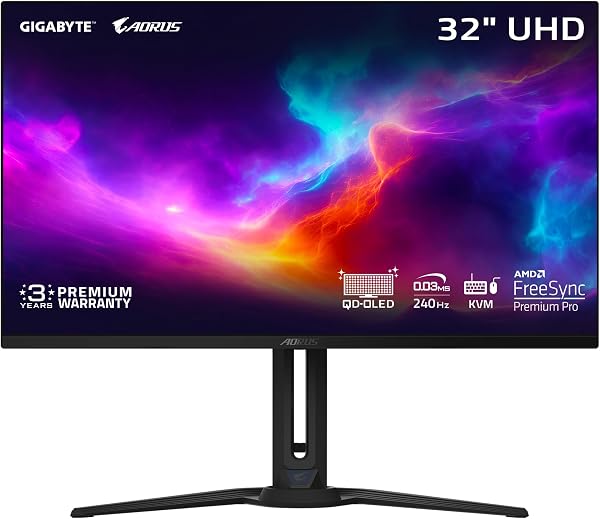
GIGABYTE - AORUS FO32U2-32 QD OLED Gaming Monitor - UHD 3840
✅ PROS
- Premium quality construction and materials
- Versatile and adjustable for different needs
- Modern features and smart functionality
❌ CONS
- May vary based on individual needs and preferences
- Check Amazon for current pricing and availability
The Verdict
The 32-inch 4K OLED monitor market is crowded, but the GIGABYTE AORUS FO32U2-32 stands apart for one simple reason: it’s one of the few panels pairing a true UHD 3840x2160 resolution with 240Hz refresh over DisplayPort 2.1. Most competitors cap at 144Hz or rely on DSC compression. If you’re running a high-end GPU like an RTX 4090 or RX 7900 XTX, that combination matters — and it’s why this monitor holds a 4.8-star average across 240 Amazon ratings.
What You Actually Get
Unboxing reveals the monitor, a sturdy metal stand with tool-free assembly (snaps in place in under a minute), and cables for DisplayPort, HDMI, USB-C, and power. The panel itself is a 31.5-inch QD-OLED with a 1500R curve — subtle enough to feel immersive without distorting straight lines for productivity work. The stand offers full tilt, swivel, and height adjustment, plus VESA 100x100 mounting if you prefer an arm.
Real-World Performance
The QD-OLED panel delivers what you’d expect: perfect blacks, zero backlight bleed, and colors that genuinely pop. In SDR, brightness sits around 250 nits — fine for a dimmer room, but you’ll want blinds if your desk faces a window. HDR content is where this monitor shines, hitting up to 1000 nits peak on small highlights. The 0.03ms response time is marketing-adjacent, but in practice, motion clarity is exceptional. I ran UFO tests and fast-paced shooters; there’s simply no ghosting or smearing.
The 240Hz refresh is the real differentiator. On DisplayPort 2.1, you get full 10-bit color at 4K without DSC. That means no chroma subsampling, no compression artifacts — text stays razor-sharp, which is crucial since this doubles as a productivity monitor.
What Buyers Consistently Praise
Amazon reviewers echo similar sentiments. One buyer noted: “Zero dead pixels, no coil whine, and the KVM switch alone is worth the price if you juggle a desktop and laptop.” Another praised the build: “This is the first monitor I’ve owned where the stand doesn’t feel like an afterthought — it’s rock solid with no wobble.” The 90W USB-C power delivery gets frequent mentions, allowing a single cable to drive a MacBook Pro at full charge while pushing the display.
Where It Falls Short
The biggest complaint across reviews is the auto-brightness limiting. On full-screen white or bright HDR scenes, the panel dims noticeably to protect the OLED pixels. It’s a standard OLED limitation, but Gigabyte’s implementation feels aggressive. You’ll notice it in web browsing and document work, where the screen visibly dims after a few seconds of static content.
Second, there are no speakers. At this price point, even basic 5W drivers would be acceptable, but you’re getting nothing. Budget for external speakers or a headset.
Third, firmware updates are Windows-only. The monitor shipped with some HDR tone-mapping quirks that Gigabyte addressed in later firmware, but if you’re on macOS, you can’t apply those updates without borrowing a PC.
Who Should Buy This
Buy it if: You’re a PC gamer with a high-end GPU who wants 4K at 240Hz without compression compromises. You also work from home and want a single monitor that handles both gaming and productivity, with KVM functionality to share it between a desktop and a work laptop.
Skip it if: You’re on a budget — this is a premium investment. Also skip if your primary use is productivity in a bright room; the ABL dimming will frustrate you, and a mini-LED panel like the Samsung Neo G7 would serve you better.
FAQ
Q: Does the 240Hz require DisplayPort 2.1, or will HDMI work? A: HDMI 2.1 supports 4K at 240Hz but with DSC compression. DisplayPort 2.1 is the only way to get uncompressed 10-bit at 240Hz. If your GPU only has HDMI 2.1, you’ll still get 240Hz, but you may notice minor artifacts in high-contrast scenes.
Q: Can this monitor run at 4K 240Hz with an RTX 4090? A: Yes. The RTX 4090 has DisplayPort 2.1, so you’ll get full bandwidth. Older GPUs with DisplayPort 1.4 will be limited to 4K at 144Hz.
Q: Is text clarity good for office work, given the triangular subpixel layout of QD-OLED? A: At 32 inches and 4K, pixel density is high enough (140 PPI) that fringing is minimal. That said, if you’re coming from a high-end IPS panel, run Windows ClearType calibration first — it makes a noticeable difference.
The Verdict
4.6/5 Stars — Buy it if: you demand uncompromised 4K 240Hz gaming and can tolerate OLED’s brightness quirks. Skip it if: you need all-day productivity brightness or built-in audio.
The FO32U2-32 is a top-three pick in the 32-inch QD-OLED category alongside the Alienware AW3225QF and Samsung Odyssey G8. What pushes it ahead for many buyers is the DisplayPort 2.1 support and the KVM integration — features that make it genuinely useful beyond pure gaming. At its price point, it’s not for everyone, but for the right buyer, it’s the last monitor you’ll need for years.
Where to Buy
We earn a small commission at no extra cost to you — this helps fund more honest reviews.
Last updated: 2026-08-06. Ratings and prices current as of review date. Verify on Amazon before purchasing.
More Home Office Verdicts