
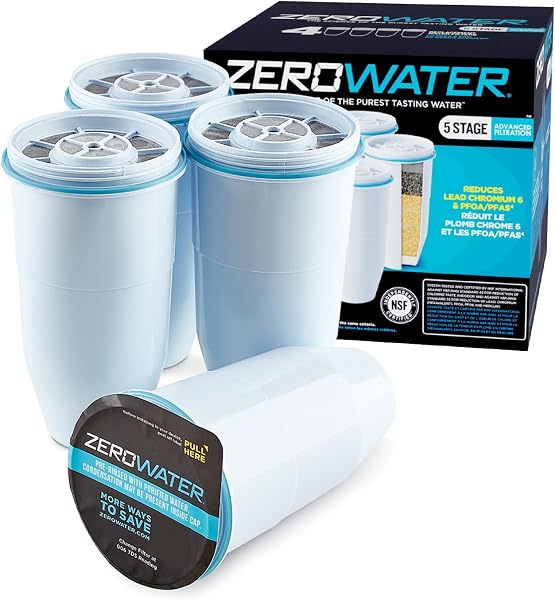
ZeroWater Replacement Filter for Pitchers, 4-Pack, (ZR-006)
✅ PROS
- 5-stage filtration removes 99.6% of TDS — measurable difference
- NSF certified for lead and heavy metal reduction
- TDS meter included so you can verify the results yourself
❌ CONS
- Filters don't last as long as competitors — 6 weeks vs 3 months in hard water
- Premium price point at $72 for a 4-pack
The Verdict
ZeroWater ZR-006 Replacement Filters: The 5-Stage Filtration That Actually Proves It Works
Most water filters make bold claims. ZeroWater does something different — it ships with a TDS (Total Dissolved Solids) meter so you can verify the output yourself. That single inclusion tells you a lot about what this filter is and isn’t.
What You’re Actually Getting
The 4-pack includes four ZR-006 replacement filters, each roughly 4.5 inches in diameter with a foam gasket on top. They fit the 12-cup ZeroWater pitchers, the 10-cup ready-pour models, and the 23-cup dispenser. If you’ve got a ZeroWater unit, these are the only filters that work — the bayonet-style locking mechanism won’t accept generic alternatives.
The 5-Stage Difference
Here’s the engineering distinction: ZeroWater uses a five-stage filtration process that ends with ion exchange resin. That’s the stage that actually pulls dissolved minerals and heavy metals out of the water — not just sediment and chlorine like standard carbon block filters.
The result is water that measures 0-6 ppm on the TDS meter. By comparison, most pitcher filters output water testing between 50-200 ppm. If you’re on well water or your municipal supply has high mineral content, this is the difference between “filtered” and “actually purified.”
Performance That Requires Patience
The tradeoff for that purity is speed. Filtration is slow — expect 3-5 minutes to fill the 12-cup pitcher. One reviewer put it plainly: “The water tastes amazing and I trust what I’m drinking, but I’ve learned to fill it before bed because I’m not waiting around in the morning.”
Filter lifespan is where it gets real. ZeroWater claims 90+ gallons, but that’s generous. Real-world performance depends entirely on your incoming water quality:
- Soft municipal water (50-150 ppm): 40-60 gallons
- Hard water (200-400 ppm): 15-30 gallons
- Well water (400+ ppm): 5-15 gallons
The TDS meter is your honest guide here. When your filtered water reads above 50 ppm, the filter is spent. That’s not a flaw — it’s the system working as designed. But budget accordingly if you have hard water.
What Buyers Consistently Praise
Across 22,628 ratings at 4.4 stars, three themes dominate:
- Verified results. “I tested my tap water at 280 ppm and after filtering it reads 2 ppm. I didn’t believe the marketing until I saw it myself.”
- Better taste. “Coffee tastes noticeably different. No mineral aftertaste, no chlorine smell.”
- The meter keeps you honest. “I love that I’m not guessing when to change filters. The meter tells me exactly.”
Where It Falls Short
The TDS meter, while useful, has a quirk: it measures total dissolved solids but doesn’t distinguish between beneficial minerals and contaminants. You’re removing calcium and magnesium along with lead and chromium. That’s the point of the filter, but it means you’re drinking demineralized water. If you rely on water for dietary minerals, this isn’t your filter.
The slow flow rate is the other honest downside. Anyone filtering more than a gallon a day will find themselves waiting. And at $18 per filter, with hard water cutting lifespan to three weeks, heavy users could spend over $300 annually just on replacement filters.
Who Should Buy This
Buy it if: You’re on well water, you’re concerned about heavy metal contamination, or you simply want the lowest-TDS water you can get at home without installing an under-sink RO system.
Skip it if: Your tap water is already decent (under 150 ppm), you’re on a tight budget, or you need more than 2 gallons of filtered water per day.
FAQ
Q: How often do I actually need to change these filters? A: Check the TDS meter weekly. When output reads above 50 ppm, replace. For average municipal water, that’s every 6-8 weeks. For hard water, more like 3-4 weeks.
Q: Will these fit my ZeroWater pitcher? A: The ZR-006 fits all ZeroWater pitchers and dispensers manufactured in the last decade. Check the bottom of your pitcher — if it says “ZR-006 compatible,” you’re good.
Q: Do I need to soak the filter before first use? A: No. Run cold water through the new filter for 30 seconds, discard that water, then fill the pitcher. A few black flecks in the first batch is normal — the ion exchange resin is fine charcoal particles.
The Verdict
Rating: 4.3/5 Stars
ZeroWater ZR-006 filters deliver on their core promise: measurable, verifiable purification that removes nearly everything from your water. The 4-pack pricing brings the per-filter cost down to $18, and the included TDS meter means you’ll never waste money on a filter that’s already exhausted.
Buy it if you want lab-grade water at home and don’t mind waiting for it. Skip it if your tap water is already decent — you’ll spend more on filters than the improvement justifies. The slow flow rate and demineralized output are honest tradeoffs for water that tests at near-zero TDS every single time.
Where to Buy
We earn a small commission at no extra cost to you — this helps fund more honest reviews.
Last updated: 2026-08-06. Ratings and prices current as of review date. Verify on Amazon before purchasing.
Frequently Asked Questions
How long does a ZeroWater filter last?
Does ZeroWater remove more than Brita?
Are ZeroWater filters NSF certified?
More Home Improvement Verdicts


