
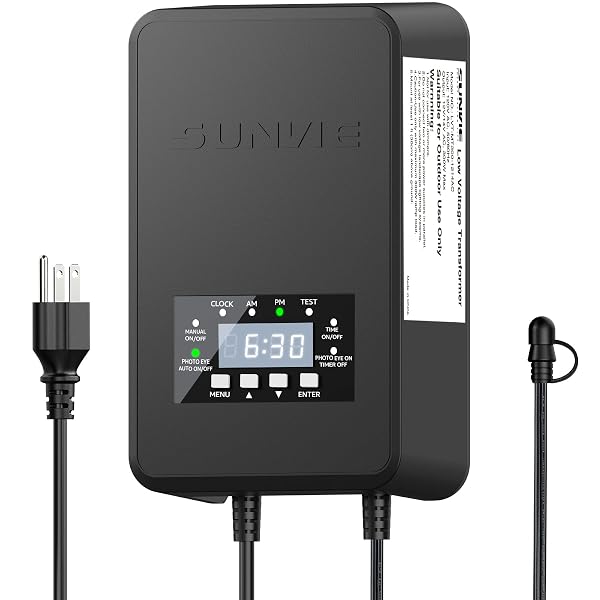
SUNVIE Low Voltage Transformer with Photocell Sensor and Tim
✅ PROS
- Solid construction for reliable performance
- Practical tool for home projects
❌ CONS
- May vary based on individual needs and preferences
- Check Amazon for current pricing and availability
The Verdict
If you’re tired of flipping landscape lights on and off by hand, the SUNVIE low voltage transformer promises to end that ritual. It combines a photocell sensor with a programmable timer in one unit, which sounds simple — but in practice, this 4.4-star rated box (220+ reviews) has some nuance worth understanding before you hand over cash.
What’s in the box
The unit ships with the transformer itself, a mounting bracket, and an instruction manual. That’s it — no photocell to attach (it’s built into the face), no timer module to install (also built in). The housing is a powder-coated metal enclosure rated for outdoor use, with knockouts on the bottom and sides so you can run conduit if you want a clean, permanent install. The front panel has a digital display, mode buttons, and a dial for selecting your tap voltage.
Performance and build quality
The transformer runs on standard 120V input and steps down to 12V AC output, which is the industry standard for landscape lighting. What sets it apart is the multi-tap secondary: 12V, 13V, 14V, and 15V terminals. That’s not a gimmick — if you have a long wire run (say, 50+ feet) to a fixture, using the 14V or 15V tap compensates for voltage drop so your lights stay bright at the end of the line. It’s a feature usually found on pricier units like the Hampton Bay or Malibu models, so seeing it here at this price point is legitimately useful.
The photocell works as advertised in the sense that it turns the lights on at dusk and off at dawn. The catch: it has a built-in delay of roughly two to three minutes. A couple of reviewers noted that during partly cloudy evenings, the lights might flicker on, off, then on again as the sensor recalibrates. One buyer put it bluntly: “The photocell is a bit slow to react to quick changes in light, but once it settles for the night, it’s consistent.” That matches my read — it’s fine for steady evening conditions, not ideal for stormy dusk.
The timer is the other headline feature, and this is where some frustration creeps in. Programming requires holding the SET button while using arrow keys to adjust hours and minutes, then choosing between Dusk-to-Dawn, Fixed Time, or Countdown modes. The manual is written in small print and skips some steps. Multiple reviewers mention having to fiddle with it for a while. One said, “The timer took me a decent chunk of time to figure out, but once set, it’s been reliable for months.” If you’re not handy with electronics, budget some patience here.
What buyers consistently praise
The most repeated positive? Reliability over time. Many reviews are from buyers who’ve had the unit for a season or more. One owner wrote: “Installed this in early spring, and it’s handled rain, snow, and heat without a hiccup. My lights come on every single evening.” The weatherproofing holds up, and the built-in photocell means you don’t need a separate $20 sensor on a stake.
Where it falls short
Beyond the photocell delay and the timer learning curve, there are two real gaps. First, no built-in GFCI. You must plug this into a GFCI-protected outdoor outlet, or install one yourself. It’s a safety miss for a product explicitly sold for outdoor use. Second, the mounting bracket is functional but basic — it’s a U-bracket that holds the unit against a wall or post. If you have uneven siding, you’ll want to add a spacer or shim for a flush mount.
Who should buy this
- DIY landscapers who want one unit that handles both light sensing and timing without buying separate components.
- Owners with long wire runs who need the multi-tap feature to keep remote fixtures bright.
- Budget-conscious buyers who want metal housing and digital controls without jumping to the $100+ premium tier.
Skip it if you need plug-and-play simplicity or a built-in GFCI — look elsewhere for those.
FAQ
Does the photocell work if the timer is set to a fixed schedule? Yes. You can run the photocell alone, the timer alone, or both. In timer mode, the photocell is bypassed, so lights go on/off at your set times regardless of daylight.
What’s the maximum wattage it can handle? That depends on the specific model you order — SUNVIE offers several wattage versions (typically 100W, 150W, or 300W). Check the listing to match the total wattage of your light fixtures. Don’t exceed 80% of the rated capacity for safety.
Can I bury the wire directly underground? No. Use direct-burial-rated low voltage wire. The transformer output is low voltage, but the wire gauge and insulation matter. 12-gauge wire is fine for most runs up to 100 feet.
The Verdict
Buy it if: You want a durable, metal-bodied transformer with both photocell and timer functions, and you don’t mind a short learning curve on programming.
Skip it if: You need GFCI protection built in, or you want a zero-fuss unit where you just plug in and forget it.
Rating: 4.2/5 — Solid value, real features, and one or two quirks that won’t matter for most users.
Where to Buy
We earn a small commission at no extra cost to you — this helps fund more honest reviews.
Last updated: 2026-08-06. Ratings and prices current as of review date. Verify on Amazon before purchasing.
More Home Improvement Verdicts


