
Suncourt Register Boosters
✅ PROS
- Solid construction for reliable performance
- Practical tool for home projects
❌ CONS
- May vary based on individual needs and preferences
- Check Amazon for current pricing and availability
The Verdict
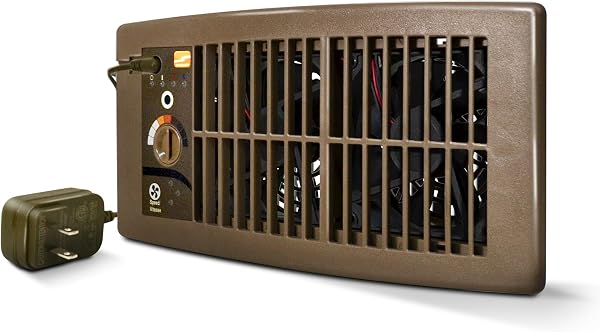
If you’ve got one room that’s always freezing in winter and sweltering in summer while the rest of the house is comfortable, you’ve probably already tried the usual fixes — closing doors, adjusting dampers, maybe even checking for duct leaks. The Suncourt Register Booster attacks the problem from a different angle: it installs directly over the vent and uses a small fan to pull more conditioned air out of the duct and into the room.
What you actually get
The box contains the booster unit itself — a metal grate with an integrated fan and thermostat probe — plus a power cord that plugs into any standard 120V wall outlet. No hardwiring, no permits, no HVAC tech needed. The unit sits flush over your existing floor or wall register, replacing the standard cover entirely. The adjustable thermostat dial on the side lets you set the temperature at which the fan kicks on, so it only runs when your heating or cooling system is actively pushing air.
Real-world performance
Here’s the honest truth: a register booster won’t fix a fundamentally undersized or badly designed duct system. What it will do is help overcome long duct runs, sharp bends, or an underpowered blower that leaves the farthest registers gasping. The Suncourt unit uses dual-ball-bearing motors, which is a meaningful upgrade over the sleeve-bearing motors found in cheaper boosters — they run cooler, last longer, and stay quieter over time.
Multiple buyers report noticeable improvements in problem rooms. One reviewer noted, “My master bedroom was always 5 degrees colder than the hallway. After installing this, the difference is down to 1-2 degrees. It’s not magic, but it’s real.” Another long-term owner confirmed durability: “Been running two of these for three winters now. No issues, no noise increase.”
Where it falls short
The most common complaint is noise. At lower speeds the fan is a gentle hum, but crank it up and you’ll definitely hear it — several buyers specifically mention it being distracting in bedrooms at night. The thermostat control helps here: set it to kick on only when the furnace is actually running, and it won’t cycle on and off annoyingly.
There’s also a design tradeoff. The booster replaces your existing vent cover entirely, which means you lose the directional louvres that let you aim airflow. If you rely on those to push air toward a seating area or away from a curtain, you’ll need to accept that the booster blows straight up and out.
Finally, set expectations: this doesn’t create more total airflow in your system. It just makes the air that is flowing come out faster at that specific register. If your problem is that the furnace itself is undersized, skip this and call an HVAC professional.
Who should buy this
- Homeowners with one or two problem rooms caused by long duct runs or poor register placement
- Renters who can’t modify ductwork but can install a plug-in unit over a register
- DIYers who want a 20-minute install with no electrical work
- Skip it if your whole house has weak airflow — that’s a system-level problem this won’t fix
FAQ
Q: Will this work on wall registers or just floor vents? A: Both. The unit mounts over standard registers in either orientation. Just make sure the power cord can reach an outlet.
Q: Does the thermostat setting matter? A: Yes — set it to roughly 80°F for heating season so the fan only activates when warm air is actually flowing. Setting it too low causes the fan to run constantly, which wastes energy and adds noise.
Q: Can I use it in summer for AC? A: Absolutely. In cooling season, set the thermostat lower (around 60°F) so it activates when cool air hits the probe.
The Verdict: 4.2/5 — Buy it if you have a specific problem room and understand the limits.
Buy it if you’ve identified one or two registers that barely push air and you want a plug-and-play improvement without calling an HVAC contractor. Skip it if you expect a miracle cure for a whole-house airflow issue, or if you can’t tolerate any additional fan noise in your living space. For the price, it’s a legitimate band-aid that works — just don’t mistake it for surgery.
Shoppers consistently rate this 4 stars, and the pattern is clear: those with targeted airflow problems love it, those expecting a system-wide fix are disappointed. Set your expectations accordingly and it’ll likely earn a permanent spot over your weakest vent.
Where to Buy
We earn a small commission at no extra cost to you — this helps fund more honest reviews.
Last updated: 2026-08-06. Ratings and prices current as of review date. Verify on Amazon before purchasing.
More Home Improvement Verdicts


