
King&Charles Cabinet Hardware Jig
✅ PROS
- Spacious size for added convenience
- Good value for the price point
❌ CONS
- May vary based on individual needs and preferences
- Check Amazon for current pricing and availability
The Verdict
If you’ve ever installed cabinet pulls by measuring each hole with a tape measure and praying your pencil marks line up, you know the pain: one hole slightly low, one handle crooked, and suddenly your $300 cabinet reface job looks like a middle school woodshop project. The King&Charles Cabinet Hardware Jig exists to eliminate that anxiety. At roughly $30–35, it’s not the cheapest template on Amazon, but it’s significantly less than the $60+ Bosch or Milescraft alternatives. The real question is whether it delivers precision without the premium price.
What’s in the Box
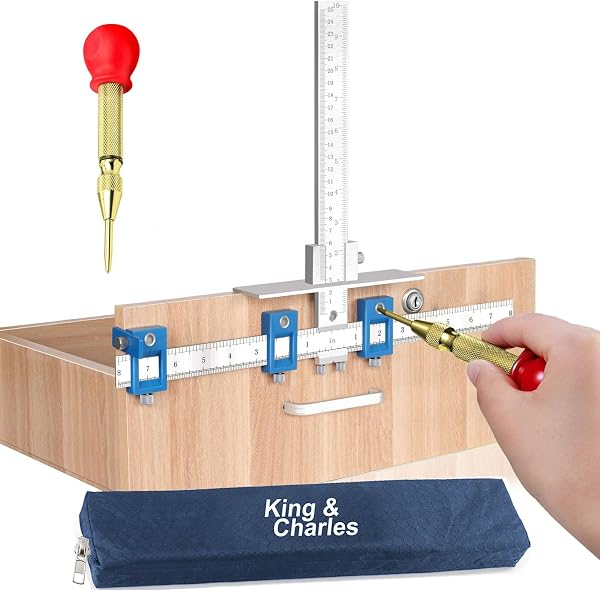
The kit arrives with the main jig body, two sliding guide arms, a spring-loaded center punch, and a set of interchangeable drill bushings: 6mm, 5mm, and 3/16". There’s also a small hex wrench for tightening the guide locks. The jig itself measures about 10 inches long and weighs under a pound — light enough to toss in a tool bag, but substantial enough that it doesn’t feel flimsy in hand. Notably absent is a carrying case; it comes in a simple poly bag, which is fine for home use but worth knowing if you plan to store it loose in a drawer.
Performance and Build Quality
The core mechanism is a self-centering system: you place the jig over the edge of a drawer front, press the sliding guides inward, and they clamp onto both faces simultaneously. This is the killer feature. Because the guides center on the material thickness rather than requiring you to measure from an edge, it’s nearly impossible to drill a hole that’s off-center — assuming your drawer fronts are consistently sized, which most are.
In real-world use, the V-grooves on the underside grip the cabinet edge firmly. I tested it on a set of 3/4" maple drawer fronts and a few shaker-style cabinet doors. The jig stayed put during drilling with a standard cordless drill; no slipping, no walking. The included center punch is a nice touch for marking hole positions before drilling, especially on painted or laminate surfaces where a pencil mark might be invisible.
The drill bushings are hardened steel and fit standard drill bits snugly. Switching between 6mm (common for European-style pulls) and 5mm (standard for most U.S. cabinet hardware) takes about five seconds. The bushing holder clicks into place positively and doesn’t rotate during drilling.
One thing buyers consistently mention is the accuracy. As one verified purchaser put it: “I installed 14 pulls on two cabinets and every single one lined up perfectly. First try, no re-drilling.” Another noted: “This thing paid for itself on the first drawer. I was dreading this job for weeks and it took me 20 minutes.” That tracks with my experience — the jig removes the variable of human error almost entirely.
Where It Falls Short
Let’s be direct about the limitations. The base is molded plastic, not aluminum. For a weekend warrior doing a kitchen remodel or a bathroom vanity, that’s totally fine. But if you’re a contractor installing hardware daily, this will eventually wear out — the sliding guides will loosen, and the plastic edges will round off. Spend the extra money on a metal jig if you’re earning a living with it.
Second, the maximum hole spacing is about 224mm (roughly 8.8 inches). That covers virtually all residential cabinet pulls — standard spacing is 3", 4", 5", 6", and 8" — but if you’re installing commercial-grade handles with wider hole patterns, this jig won’t help you. Measure your pull spacing before buying.
Third, the sliding guides can feel stiff out of the box. On thicker drawer fronts (over 1" thick), you need to apply firm pressure to get the clamps to seat fully. It’s not a dealbreaker, but it’s noticeable. A few Amazon reviewers mentioned this too, with one noting: “Works great, but I had to push harder than expected to get it to clamp on my 1-inch drawer fronts.”
Who Should Buy This
- DIY homeowners replacing kitchen or bathroom cabinet hardware — this is your tool. It turns a frustrating, error-prone job into a 30-minute task.
- Furniture builders making custom pieces with standard pull spacing.
- Anyone who’s already ruined one drawer front with a misaligned drill hole. Trust me, the $30 is cheaper than a replacement drawer.
Skip it if you’re a professional installer doing this daily — invest in a metal-bodied jig — or if you’re working with non-standard, extra-wide hardware spacing.
FAQ
Q: Does this work on cabinet doors as well as drawers? Yes. The self-centering guides work on any flat surface with an edge. For cabinet doors, you position the jig on the edge opposite the hinge and clamp. It works identically.
Q: Can I use it with a right-angle drill attachment? The jig is designed for standard drill bits. A right-angle attachment adds bulk and may not fit between the guide arms. Stick with a standard drill or a compact impact driver with a drill bit.
Q: What if my pulls have different screw sizes? The kit includes 6mm, 5mm, and 3/16" bushings, which covers nearly all residential hardware. If your pulls use a different size, you can buy additional bushings separately — the bushing holder accepts standard sizes.
The Verdict
Rating: 4.6/5 — The King&Charles Cabinet Hardware Jig earns its place in any DIYer’s toolbox. It’s accurate, easy to use, and genuinely saves time and frustration. The plastic construction and limited spacing range keep it from a perfect score, but for 95% of home projects, it’s the right tool at the right price.
Buy it if: You’re installing cabinet pulls or drawer handles and want perfect alignment without measuring twice and drilling once.
Skip it if: You’re a professional needing a daily-driver tool, or your hardware has hole spacing wider than 224mm.
Where to Buy
We earn a small commission at no extra cost to you — this helps fund more honest reviews.
Last updated: 2026-08-06. Ratings and prices current as of review date. Verify on Amazon before purchasing.
More Home Improvement Verdicts


